Workshop lead facilitator brief biography
Tanya LaPier has been a Distinguished Professor of Physical Therapy at Eastern Washington University. She earned her BS in Physical Therapy from Ithaca College, MS in Exercise Physiology from State University of New York at Buffalo, and PhD in Cardiovascular Physiology from Idaho State University. Dr. LaPier has been a Board-Certified Specialist in Cardiopulmonary Physical Therapy for 20 years, has published over 80 articles in peer-reviewed journals, and made over 100 presentations at international/national meetings in the area of cardiovascular and pulmonary physiology and clinical practice. She is an Associate Editor for the Journal of Acute Care Physical Therapy.
Workshop submission
WORKSHOP FACILITATORS: The multi-disciplinary, globally diverse panel will present content in their area of research and expertise.
OBJECTIVES: At the conclusion of this workshop participants will:
1) Understand current world-wide application and research basis of sternal precautions.
2) Be able to implement timely and progressive activity and exercise in patients recovering from open heart surgery.
3) Apply clinical reasoning to develop individualized care plans for patients 1 day to 1 year following median sternotomy.
COURSE DESCRIPTION:
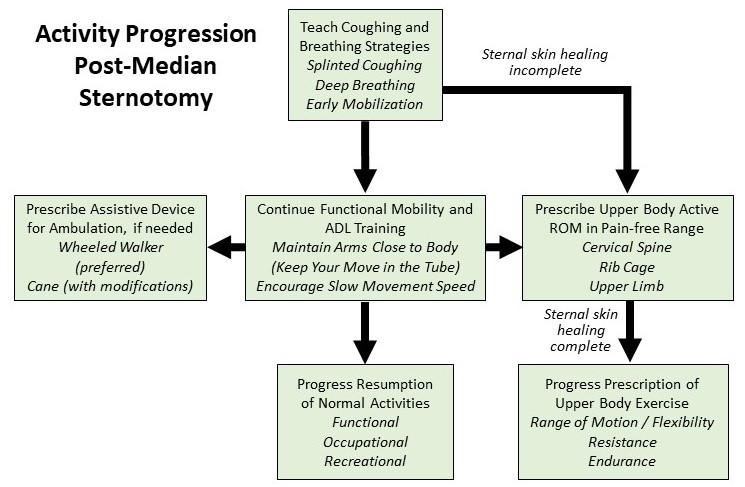
There is a growing foundation of research evidence that upper body activity can be initiated safely soon after cardiac surgery performed via median sternotomy. Traditional sternal precautions often restrict upper extremity (UE) range of motion, lifting, pushing, and pulling. These limitations can lead to loss of independence and disuse-associated sequelae such as muscle weakness and connective tissue shortening. We will present a conceptual approach to facilitate changing the current clinical culture of limiting activity to one that encourages optimal and timely recovery for patients following median sternotomy using a recently published algorithm (El-Ansary, LaPier, and Adams et al. Phys Ther. 99:1587–1601) for the resumption and progression of activity. The framework of this course will start from early resumption of functional activity and then continue through the progression of therapeutic exercise prescription. A clinical paradigm shift is proposed, that encourages a greater amount of UE activity, albeit modified in some situations, and less restrictive sternal precautions. Early screening for sternal complication risk factors and instability followed by individualized progressive of functional activity and upper body therapeutic exercise is likely to promote optimal and timely patient recovery.
This workshop will focus the individualized therapeutic prescription of activity and exercise for patients 1 day to 1 year following median sternotomy. We will discuss the new conceptual framework “Keep Your Move in the Tube” that advocates moving away from load and time restrictions imposed by traditional sternal precautions and to reduce force across the sternum by focusing on the lever arm portion of the torque equation. These principles were translated using simple graphics depicting favorable movements “in a green tube” and unfavorable movements “out of a red tube.” Next the role of early, progressive, and individualized therapeutic exercise that addresses joint mobility, aerobic capacity, and muscle strength will be discussed. A summary of research related to the benefits and ideal parameters for aerobic exercise training will be provided. Finally, current evidence on the safety and implementation of resistance training for patients following median sternotomy will be provided. Resistance training for this patient population has traditionally been avoided at least in the early stages of rehabilitation.
INTERACTIVE ACTIVITY: The workshop will conclude with the presentation of patient cases and application of the algorithm presented. Lastly a period of questions, answers, and comments between the audience and presenters will allow for a multidisciplinary discussion on this important topic.
ACRA MISSION: This workshop will promote the mission of ACRA to “deliver evidence-based best practice across the continuum of cardiovascular care” by presenting current relevant research and patient care model.