To save this page as a PDF, click this button and choose the PDF destination.

Stream 6 (Frontiers): Development and Applications in Super Resolution Microscopy

14:15 - 16:15 Wednesday, 7th July, 2021

Sessions Frontiers Conference Session

Session Organiser Jessica Valli

The emergence of super resolution light microscopy techniques in the last quarter-century has allowed researchers to probe further into the hitherto unseen depths of biology and ‘resolve’ many previously-unanswered questions. While there are now several commercially-available super resolution systems, these techniques are still anything but mundane, and new developments continue to push the limits of resolution closer to those achievable by electron microscopy. This session will focus on both the most recent developments in super resolution microscopy and the applications of these techniques to biological frontiers.


14:15 - 14:45

146 Long-term and multi-colour STED microscopy of the living mouse brain

Dr. Katrin Willig
Max Planck Institut of Experimental Medicine, Göttingen, Germany

Abstract Text

From all super-resolution microscopy techniques currently available, STED microscopy stands out for its imaging capabilities in tissue: It is live-cell compatible, able to record 3D images from inside transparent tissue and has a fast imaging speed. Although STED microscopes are commercially available and widely used today, in vivo applications are still rare. Here I will present recent advances on extending the imaging period of STED microscopy of the mouse neocortex for up to one month. Moreover, we combine spectrally separated excitation and emission with reversible switchable fluorescent proteins to establish quasi-simultaneous imaging of three channels. We apply these techniques to imaging of synapses, which are the communication sites between neurons and are believed to represent the principal units for memory and learning. Modulations of the synapse morphology are closely linked to changes in synaptic transmission. Recent evidence also suggest that synaptic proteins and receptors are organized in a nanopattern which is highly dynamic may play a role in synaptic function. With our advances in extending the observation time and multi-label detection, the in vivo STED technique is becoming a powerful tool for observing the morphology and plasticity of the synaptic protein nanoorganization with nanoscale resolution in the intact animal.

Keywords

superresolution, nanoscopy, STED microscopy, in vivo imaging, dendritic spine, nanoorganization, multi-colour imaging, light microscopy


14:45 - 14:57

76 Automated studies of the structure of multimer complexes of the EGFR on cells at ~4 nm resolution:  Elucidating structure-function relationships in cancer

Dr Sumanth Iyer, Dr Benjamin Davis, Dr Laura Zanetti Domingues, Dr Selene Roberts, Dr Daniel Rolfe, Professor Marisa Martin-Fernandez
Central Laser Facility, STFC Rutherford Appleton Laboratory, Didcot, United Kingdom

Abstract Text

A crucial step in the evolution of multi-cellular organisms was the emergence of receptor tyrosine kinases (RTKs). Trafficked to the plasma membrane, their role is to transduce signals in response to cognate growth factor ligands. Epidermal growth factor receptor (EGFR) was the first RTK to be cloned and this receptor is of paramount importance to cell function and human health as mutations in EGFR and gene amplification are observed in many human cancers. Indeed, cancer is the second cause of death worldwide, accounting for an estimated 9.6 million deaths in 2018. Despite ~4 decades of EGFR research, the information on EGFR structure derived from cell-free methods still does not explain the mechanisms underpinning either its normal function, or its dysregulation in cancer. Determining the structure-function relationships of EGFR in cells is of paramount important to find better cancer treatments.

As part of efforts to determine the structure of the EGFR in the physiological cell context, we developed a single molecule localisation imaging-based, super-resolution method, coined fluorophore localisation imaging with photobleaching (FLImP). By exploiting molecular fluorescent photobleaching steps to localise molecules co-located within diffraction-limited spots, this method measures the lateral separation (r) between such molecules with ~4 nm resolution. Using FLImP in concert with fluorescence resonance energy transfer (FRET), to measure EGFR residue-to-plasma membrane separation (z dimension), and long-time-scale molecular dynamic simulations, we determined the atomic resolution structures of ligand-bound, and ligand-free EGFR dimers and oligomers at the plasma membrane of cells (Needham et al., Nat Comms 2016; Zanetti-Domingues et al., Nat Comms 2018). These results shed new light on the mechanisms of EGFR autoinhibition and phosphorylation, in both normal and dysregulated signalling.

We have since added a second spatial dimension to FLImP (from lateral r to independent measurement of x,y dimensions). In addition, to make FLImP easier to use, we automated the data collection and analysis processes. Using a palette of strategic mutations, we have recently found that EGFR uses an autoinhibitory, fail-safe mechanism, which relies on extracellular, transmembrane, and intracellular contacts, some of which are resistant to the onset of cancer mutations. These data are currently beginning to unravel the structure-function relationship encoding the behaviour of cancer mutants responsible for the development of therapeutic resistance, thus revealing potential new candidates for therapeutic intervention.


Keywords

EGFR, Tyrosine Kinases, single-molecule, fluorescence, cancer, signalling, super-resolution

References

Needham, S.R., Roberts, S.K., Arkhipov, A., Mysore, V.P., Tynan, C.J., Zanetti-Domingues, L.C., Kim, E.T, Losasso, V., Korovesis, D., Hirsch, M., Rolfe, D.J., Clarke, D.T., Winn, M., Lajevardipour, A., Clayton, A.H.A. Pike, L.J., Perani, M., Parker, P.J., Shan, Y, Shaw, D.E. & Martin-Fernandez, M.L. EGFR oligomerization organizes kinase-active dimers into competent signalling platforms.  Nat Comms (2016) DOI: 10.1038/ncomms13307

Laura C. Zanetti-Domingues, Dimitrios Korovesis, Sarah R. Needham, Christopher J. Tynan, Shiori Sagawa, Selene K. Roberts, Antonija Kuzmanic, Elena Ortiz-Zapater, Purvi Jain, Rob C. Roovers, Alireza Lajevardipour, Paul M.P. van Bergen en Henegouwen, George Santis, Andrew H.A. Clayton, David T. Clarke, Francesco L. Gervasio, Yibing Shan, David E. Shaw, Daniel J. Rolfe, Peter J. Parker, and Marisa L. Martin-Fernandez. The architecture of EGFR's basal complexes reveals autoinhibition mechanisms in dimers and oligomers. Nat Comms (2018) DOI:10.1038/s41467-018-06632-0.


15:05 - 15:08

66 High resolution reflection microscopy via absorbance modulation

Parul Jain1, Viktor Udachin2, Sven Nagorny3, Dr. Claudia Geisler1, Apl. Prof. Dr. Jörg Adams4, Prof. Dr. Andreas Schmidt3, Prof. Dr. Christian Rembe5, Apl. Prof. Dr. Alexander Egner1
1Institut für Nanophotonik, Göttingen, Germany. 2Clausthal Center of Materials Technology, TU Clausthal, Clausthal-Zellerfeld, Germany. 3Institut für Organische Chemie,TU Clausthal, Clausthal-Zellerfeld, Germany. 4Institut für Physikalische Chemie, TU Clausthal, Clausthal-Zellerfeld, Germany. 5Institute of Electrical Information Technology, TU Clausthal, Clausthal-Zellerfeld, Germany

Abstract Text

Properties of composite materials are strongly influenced by their microstructural features. The size of these features can vary from a few nanometers to several micrometers. Optical microscopy, especially reflection microscopy, is one of the primary tools for the morphological characterization in material science. However, due to the wave nature of light, it cannot be focused to an arbitrarily small spot, thereby limiting the resolution of optical microscopes to the diffraction limit that is not sufficient for the analysis of these materials. Stimulated emission depletion (STED) microscopy, which is so far mostly used in life science imaging, surpasses the diffraction limit by exploiting the properties of fluorescent markers [1]. The concept of STED has been successfully applied in optical lithography and microscopy as a technique called absorbance-modulation [2]. In absorbance modulation, a layer of photochromic molecules, referred to as absorbance modulation layer (AML), is coated on the sample that can change their absorption properties when illuminated with light of different wavelengths. Thus, they can be reversibly switched between opaque and transparent configuration in a controlled manner and consequently, increase the resolution. This technique of absorbance modulation when applied for imaging is called absorbance modulation imaging (AMI). AMI in transmission microscopy has certainly demonstrated a high lateral resolution [3]. However, AMI in reflection microscopy has not yet been demonstrated, despite its potential to analyze a much wider range of materials including opaque, transparent, and even metallic samples.

Theoretical study on AMI in confocal reflection microscopy predicts that imaging beyond the diffraction limit is indeed possible [4]. Here we experimentally validate this prediction by demonstrating one-dimensional AMI. When a one-dimensional grating sample, coated with a thin layer of AML, is illuminated with a Gaussian-shaped focus superposed with a 1-D pattern (similar to transverse laser mode 01), a dynamic aperture is generated within the AML. The size of this effective aperture is below the diffraction limit which allows to achieve sub-wavelength resolution. Further resolution improvement is possible by optimizing the illumination scheme and tailoring the optical absorption response of the AML. The one-dimensional AMI that we demonstrate here can be easily extended to two dimensions which would facilitate high resolution optical imaging of microstructural features.


Keywords

Reflection microscopy, Absorbance modulation

References

[1] S. W. Hell, J. Wichmann, Opt. Letters, Vol. 19, No. 11 (1994).

[2] R. Menon, H. I. Smith, J. Opt. Soc. Am., A 23, 2290 (2006).

[3] H.Y. Tsai, S. W. Thomas, III, R. Menon, Opt. Express, Vol.18, No. 15 (2010).

[4] R. Kowarsch, C. Geisler, A. Egner, C. Rembe, Opt. Express, 26(5), p. 5327–5341 (2018).


15:08 - 15:11

285 Modular, sustainable, low-cost, open microscopy and high content analysis

Mr Jonathan Lightley1, Dr Frederik Görlitz1, Dr Sunil Kumar1,2, Dr Ranjan Kalita1, Mr Arinbjorn Kolbeinsson1, Dr Edwin Garcia1, Dr Yuriy Alexandrov1,2, Mr Simon Johnson1, Mr Martin Kehoe1, Dr Vicky Bousgouni3, Mr Riccardo Wysoczanski1, Mr Dan Marks1, Professor Iain McNeish1, Professor Peter Barnes1, Professor Louise Donelly1, Professor Chris Bakal3, Mr Callum Hollick4, Mr Jeremy Graham4, Professor Christopher Dunsby1,2, Profesor Mark Neil1,2, Dr Seth Flaxman1, Professor Paul French1,2
1Imperial College London, London, United Kingdom. 2Francis Crick Institute, London, United Kingdom. 3Institute of Cancer Research, London, United Kingdom. 4Cairn Research Ltd, Faversham, United Kingdom

Abstract Text

Summary

We present an open source microscopy platform that can be configured for a wide range of microscopy modalities to deliver performance comparable to commercial research microscopes. Here we report an exemplar implementation of super-resolved HCA, demonstrating automated multiwell plate dSTORM implemented with a low-cost multimode diode lasers, a robust optical autofocus module and a new class of low-cost, cooled CMOS camera. These modules can be implemented with the open, modular openFrame microscope stand

Introduction

Fluorescence microscopy has been revolutionized by the development of advanced microscopy techniques including super-resolved imaging, quantitative phase contrast imaging, hyperspectral imaging. While SRM techniques, in particular, have transformed expectations for cell microscopy, commercial SRM instruments can be unaffordable for many researchers. We have been developing a range of self-built microscopes, including STED and dSTORM instruments and automated microscopes for high content analysis (HCA). Having worked to adapt legacy commercial microscope frames to new modalities, we realised that commercial microscope frames already present a significant cost to lower resource settings and proprietary hardware and software can add challenges to such self-build projects. Accordingly, we have developed a new, modular open source microscope frame, “openFrame”, that aims to minimise cost and to simplify the set-up of self-built advanced microscopes while providing research quality performance. Here we present an implementation of automated dSTORM microscopy with optical autofocus and open source software for image data acquisition and analysis. openFrame sits within our openScopes platform that aims to provide cost-effective access to advanced optical imaging techniques including high content analysis, super-resolved microscopy, quantitative phase contrast imaging and hyperspectral imaging. 
Uncaptioned visual

Methods

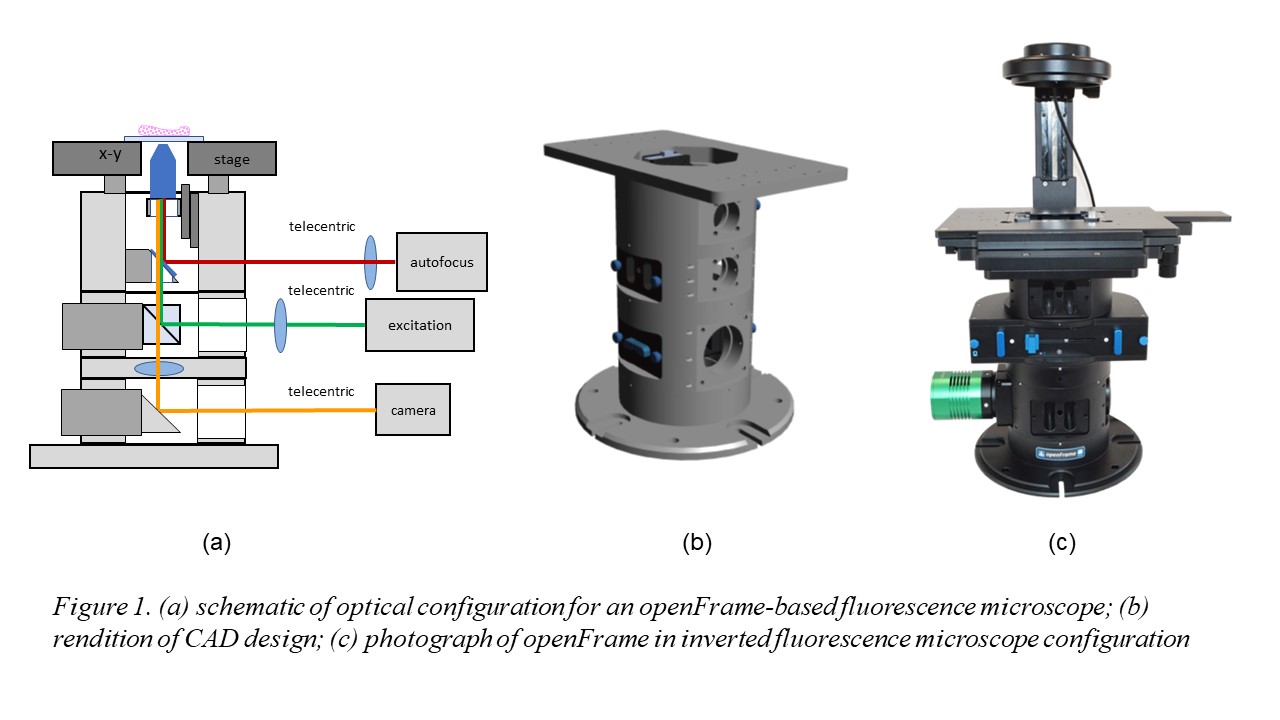
Figure 1 illustrates the openFrame concept, which is designed around a cylindrical geometry that allows straightforward centering of components along an optical axis and it is made up of different layers that can be customized as necessary for specific applications. It has been designed for straightforward manufacture using standard lathes and milling machines. openFrame has a top layer containing the objective lens mounted on a low-cost piezo-motorised stage and a beam splitter that allows an infrared laser-based autofocus unit to be deployed. We then have an excitation layer incorporating the main dichroic beamsplitter and a camera layer that includes the tube lens. This design can be easily expanded with more excitation or camera layers as required. A microscope based around the openFrame is easily maintained or modified. Furthermore, sample x-y drift measured during an acquisition of 5000 frames was less than 2 pixels (210 nm) during image acquisition, which is less than that observed with our commercial fluorescence microscope frame. 

Single molecule localisation microscopy (SMLM) techniques can enable super-resolved imaging with relative simple experimental configurations based on epifluorescence or total internal reflection fluorescence (TIRF) microscopes. SMLM is particularly straightforward to implement via dSTORM [1], which is perhaps the most easily implemented technique since it can utilise common fluorophores, and several groups have demonstrated low-cost dSTORM microscopes, e.g. [2,3,4,5]. We have developed a robust and low-cost approach, easySTORM, to implement TIRF or epifluorescence SMLM microscopy on any inverted fluorescence microscope: this utilises a multimode optical fibre for efficient light coupling and the opportunity to average laser speckle (by vibrating fibre and mixing modes) for reasonably uniform illumination. The microscope can be adjusted between TIRF and epifluorescence by steering the excitation beam to be focused at different locations in the back focal plane of the objective lens. Combining this approach with low-cost, high-power multimode laser diodes to provide high power (~1 W) excitation, results in the easySTORM capability that can be added to a standard fluorescence microscope for a component cost of ~£7000 plus the cost of the objective lens and the camera. While these components can together cost £20,000 for state-of-the art components, we and others have shown that reasonable STORM images can be acquired in epifluorescence using low-cost objective lenses and with low-cost uncooled CMOS cameras. Here we demonstrated improved, cost effective performance with a fan-cooled CMOS camera. 

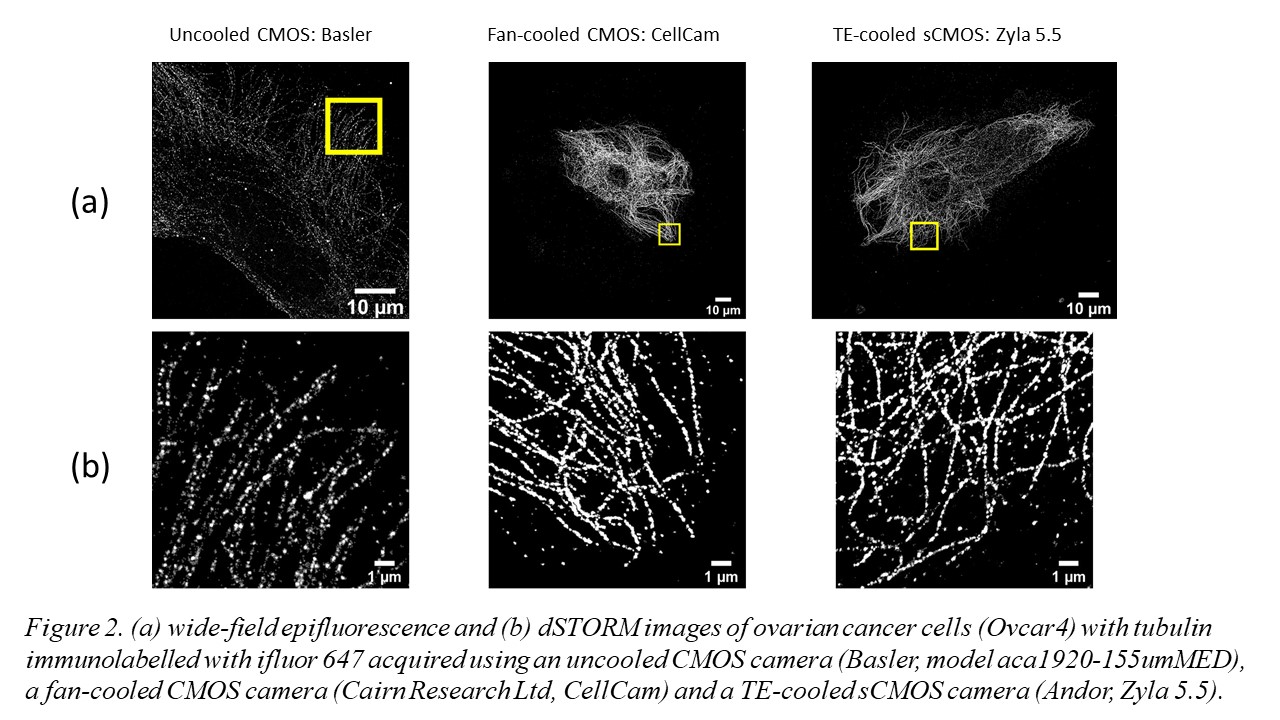
The use of multimode diode lasers improves the uniformity of illumination and provides excitation at a cost as low as £500/excitation wavelength with sufficient power to undertake STORM of samples with a field of view (FOV) >120 ×120 µm2. Such large FOV result in large (>~30 GB) data files that can require significant time (tens of minutes to hours) for SMLM data processing, e.g. using ThunderSTORM  on a desktop computer. We therefore developed a parallelized SMLM analysis approach, initially based on ThunderSTORM [6] implemented on a high-performance computing cluster [7], to process SMLM data from multiple FOV in parallel on different nodes in the HPC cluster or to accelerate the processing of SMLM data from one FOV by dividing the localisation task between multiple nodes. The ability of easySTORM to image large FOV combined with the ability to scale up the SMLM data processing rate using HPC resources are key enablers for high throughput SMLM, noting this has previously been demonstrated with PALM [8] and STORM [9]. We have developed a low-cost open source automated SMLM high content analysis platform combining easySTORM with an optical autofocus and motorised stage-scanning to enable automated multiwell plate dSTORM acquisition [10]. The autofocus module utilises a convolutional neural network (CNN) that can robustly determine the distance from focus by analysing a single image captured on the autofocus camera . Automated dSTORM has been applied to high content super-resolved imaging, including of focal adhesions in melanoma cells, and phagocytosis of bacteria. We have also explored the use of a new generation of fan-cooled CMOS cameras for SMLM, noting that the relatively high frame rate used for SMLM means that fan-cooling can provide similar SMLM performance to thermoelectric cooled sCMOS cameras, as illustrated in figure 2. 
Uncaptioned visual

Conclusions

We have presented an open microscopy platform applicable to most imaging modalities, including automated and super-resolved microscopy. Links to the open-source software to control the easySTORM microscope and for the scripts for the HPC processing of SMLM data will be provided at: https://www.imperial.ac.uk/photonics/research/biophotonics/instruments--software/open-source-software/. Further information can be found at www.openScopes.com. 


Keywords

open source, fluorescence microscopy

References

[1] Heilemann, M., et al,  Subdiffraction-resolution fluorescence imaging with conventional fluorescent probes. Angewandte Chemie (International Ed. in English), 47, 6172–6176 (2008)

[2] Holm, T., et al. “A blueprint for cost-efficient localization microscopy,” Chem-PhysChem. 15, 651–654 (2014).

[3] Kwakwa, K., et al.,. “easySTORM: a robust, lower-cost approach to localisation and TIRF microscopy,”J. Biophotonics, 9, 948–957 (2016).

[4] Ma, H., Fu, R., Xu, J., & Liu, Y. A simple and cost-effective setup for super-resolution localization microscopy. Scientific Reports, 7, 1542 (2017).

[5] Diekmann, R., et al., “Characterization of an industry-grade CMOS camera well suited for single molecule localization microscopy - High performance super-resolution at low cost,” Scientific Reports, 7, 14425 (2017).

[6] Ovesný, et al., “ThunderSTORM: A comprehensive ImageJ plug-in for PALM and STORM data analysis and super-resolution imaging,” Bioinformatics, 30, 2389–2390 (2014).

[7] Munro, I., et al., “Accelerating single molecule localization microscopy through parallel processing on a high‐performance computing cluster,” J. Microscopy 273 148-160 (2019) 

[8] Holden, et al., S. “High throughput 3D super-resolution microscopy reveals Caulobacter crescentus in vivo Z-ring organization,” Proc. Natl. Acad. Sci. U.S.A. 111, 4566–4571 (2014).

[9] Beghin, A., et al. “Localization-based super-resolution imaging meets high-content screening,”. Nature Methods, 14, 1184–1190 (2017).

[10] J. Lightley et al, “Robust optical autofocus system utilizing neural networks trained for extended range and time-course and automated multiwell plate imaging including single molecule localization microscopy”, bioRxiv (2021), https://doi.org/10.1101/2021.03.05.431171 


15:11 - 15:23

162 Correction of multiple-blinking artefacts in photoactivated localisation microscopy

Louis G Jensen1, Tjun Yee Hoh2, David J Williamson3, Juliette Griffié4, Daniel Sage5, Patrick Rubin-Delanchy2, Dylan M Owen6
1Department of Mathematics, Aarhus University, Aarhus, Denmark. 2Institute for Statistical Science, School of Mathematics, University of Bristol, Bristol, United Kingdom. 3Randall Centre for Cell and Molecular Biophysics, King’s College London, London, United Kingdom. 4Laboratory of Experimental Biophysics, Institute of Physics, EPFL, Lausanne, Switzerland. 5Biomedical Imaging Group, School of Engineering, EPFL, Lausanne, Switzerland. 6Institute of Immunology and Immunotherapy, School of Mathematics and Centre of Membrane Proteins and Receptors (COMPARE), University of Birmingham, Birmingham, United Kingdom

Abstract Text

Summary

Photoactivated localisation microscopy (PALM) produces an array of localisation coordinates by means of photoactivatable fluorescent proteins. However, observations are subject to fluorophore multiple-blinking and each protein is included in the dataset an unknown number of times at different positions, due to localisation error. This causes artificial clustering to be observed in the data. We present a workflow using calibration-free estimation of blinking dynamics and model-based clustering, to produce a corrected set of localisation coordinates now representing the true underlying fluorophore locations with enhanced localisation precision. 

Introduction

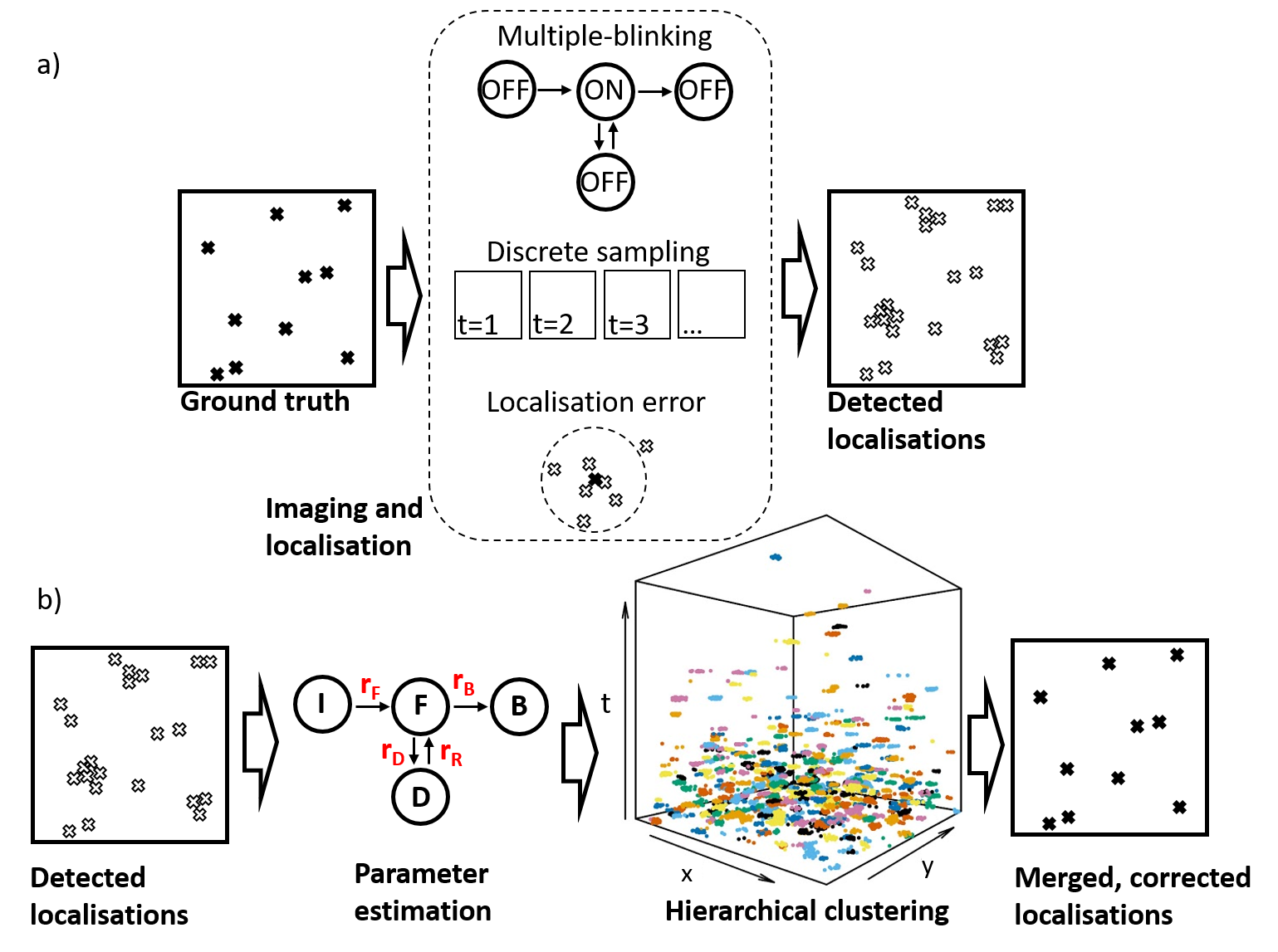
Single molecule localisation microscopy (SMLM) methods, such as PALM, circumvent the diffraction limit of light by separating fluorophore detections in time through stochastic activation and photobleaching, and then localizing the resulting sparse distribution of point spread functions [1]. The resulting point-pattern is a purported realisation of the underlying ground truth positions of the fluorophores, but is corrupted by a number of artefacts resulting from the photophysical behaviour of the probes as well as the imaging and localisation steps. Most problematic is the multiple appearance (multiple-blinking) problem where fluorophores undergo multiple on-off cycles before permanently bleaching, combined with the discretization effects that result from observing fluorescent signals on discrete camera frames [2]. The multiple-blinking problem results in data sets that are artificially clustered and overly populated (Figure 1a). As such, quantitative cluster analysis of SMLM data, in particular testing for spatial randomness of the underlying fluorophores, remains a challenge. 

Methods/Material

In this work, we present a new method (Figure 1b) for correction of multiple-blinking artefacts in PALM data, which estimates, directly from the sample data set, the parameters of a realistic model of fluorescent protein photophysics [3]. Cluster analysis of the spatio-temporal (x,y,t,σ) data set then allows computation of the marginal likelihood of any given blink-merge proposal, under a full generative model for the data. We select the most likely of several proposals generated using a customised hierarchical clustering algorithm. Finally, each blink cluster is consolidated into a single position, now free from multiple-blinking and with improved localisation precision. The overall effect is to convert the set of raw x,y,t,σ localisation data into a new set, x,y,σ, with enhanced resolution.

Results and Discussion

PALM is increasingly used in the biological sciences and owing to the properties of commonly used total internal reflection fluorescence (TIRF) illumination, the distributions of membrane proteins have been especially well studied. Despite this, because of artificial clustering resulting from multiple-blinking, the question of whether membrane proteins are randomly distributed or not has become increasingly contentious [4]. Using our validated method combined with subsequent testing of the corrected protein locations, we show that the adaptor protein Linker for Activation of T cells (LAT) is clustered in the plasma membrane of CD4+ Helper T cell lines after the formation of an artificial immunological synapse [5,6] against an activating, antibody-coated surface. However, subsequent Bayesian cluster analysis [7,8] shows the clustering properties to be dependent on its macro-scale location within the synapse and on the presence of intracellular phosphorylatable tyrosine residues which mediate protein binding. We now propose that PALM, combined with the method we present here, can be used to test for spatial randomness in other membrane protein species.

Conclusion

In conclusion, our method allows for accurate recovery of ground-truth fluorophore positions, with enhanced precision, from PALM data sets subjected to multiple-blinking artefacts. For the first time, these corrected sets are of sufficient quality to allow accurate cluster analysis and the statistical testing for complete spatial randomness. We therefore believe that PALM combined with our method will be a valuable tool for addressing questions on the existence, determinants and functions of protein nanoscale clustering.


Uncaptioned visual

Figure 1: Illustration of our workflow. a) During PALM image acquisition and subsequent localisation steps, the ground-truth protein positions are corrupted by multiple-blinking in combination with discretisation by the camera frames and scrambling by the localisation uncertainty, resulting in a data set which is over-populated and over-clustered. b) Our algorithm takes as input x,y,t,σ data and estimates the rate parameters of a 4-state photophysical model, from which it derives the total number of molecules in the ROI. This is then used as input to a hierarchical clustering step (experimental data shown with colours representing the clusters found), after which clusters are merged to their centres, creating a new dataset free from multiple-blinking and with enhanced localisation precision.

Keywords

Single molecule localisation microscopy (SMLM), Photoactivated localisation microscopy (PALM), Multiple blinking, Spatio-temporal point patterns

References

1.    Betzig, E. et al. Imaging Intracellular Fluorescent Proteins at Nanometer Resolution. Science 313, 1642-1645 (2006). 

2.    Annibale, P., Scarselli, M., Kodiyan, A. & Radenovic, A. Photoactivatable Fluorescent Protein mEos2 Displays Repeated Photoactivation after a Long-Lived Dark State in the Red Photoconverted Form. The Journal of Physical Chemistry Letters 1, 1506-1510 (2010).

3.    Jensen, L.G., Williamson, D.J. & Hahn, U. Semiparametric point process modelling of blinking artefacts in PALM. BiorXiv (2021).

4.    Rossboth, B. et al. TCRs are randomly distributed on the plasma membrane of resting antigen-experienced T cells. Nature Immunology 19, 821-827 (2018).

5.    Williamson, D.J. et al. Pre-existing clusters of the adaptor Lat do not participate in early T cell signaling events. Nat Immunol 12, 655-662 (2011).

6.    Lillemeier, B.F. et al. TCR and Lat are expressed on separate protein islands on T cell membranes and concatenate during activation. Nature Immunology 11, 90-96 (2010).

7.    Rubin-Delanchy, P. et al. Bayesian cluster identification in single-molecule localisation microscopy data. Nature Methods 12, 1072-1076 (2015).

8.    Griffié, J. et al. A Bayesian cluster analysis method for single-molecule localisation microscopy data. Nature Protocols 11, 2499-2514 (2016).


15:23 - 15:35

308 A correlative super-resolution protocol to map the local single-channel underpinnings of fast second-messenger signals in primary cell types

Dr Miriam Hurley1, Mr Thomas Sheard2,1, Dr Ruth Norman1, Dr Hannah Kirton1, Dr Shihab Shah1, Dr Eleftheria Pervolaraki1, Dr Zhaokang Yang1, Prof Nikita Gamper1, Prof Derek Steele1, Prof Ed White1, Dr Izzy Jayasinghe2
1The University of Leeds, Leeds, United Kingdom. 2The University of Sheffield, Sheffield, United Kingdom

Abstract Text

Single molecule localisation microscopy (SMLM) is a common tool in resolving the clustering patterns of proteins. One such SMLM technique is DNA-point accumulation for imaging in nanoscale topography (DNA-PAINT), which has enabled individual proteins within their clustered array to be localised and counted in situ at a spatial resolution ≤10 nm [1]However, nanometre-scale cellular information obtained through super-resolution microscopies are often unaccompanied by functional information, particularly transient and diffusible signals through which life is orchestrated. The requirement for cells to undergo fixation and permeabilisation, alongside the incompatibility across image acquisition timescales, could partially explain the absent functional context to most SMLM data. We have developed a correlative imaging protocol [2] which allows the ubiquitous intracellular second messenger, calcium (Ca2+), to be directly visualised against nanoscale patterns of the ryanodine receptor (RyR) Ca2+ channels in primary cell types. 


The RyR channel can be located across a range of vertebrate cell types and their role in mediating the release of fast Ca2+ signals, composed of Ca2+ sparks, is central to muscle force production and underpins intracellular homeostasis. The developed protocol can spatially overlay the two-dimensional (2D) total internal reflection fluorescence (TIRF) live-cell imaging of Ca2+ underneath a cell’s membrane, with the subsequent DNA-PAINT imaging of local RyR channels after cell fixation. To study the local regulation of RyR in regard to its functional release of Ca2+, we applied the experimental protocol to a drug-induced model of right ventricular (RV) heart failure. Enzymatically isolated RV cardiomyocytes were obtained from adult male Wistar rats injected with saline (Ctrl-RV) or monocrotaline (60 mg/kg) to induce pulmonary artery hypertension and compensated RV failure (MCT-RV). 


Using a semi-automated detection system [1], discretisation of individual RyR channels enabled spatial statistics of each channel to be extracted and their centroid to be detected. Within the same cellular region, Ca2+ sparks were characterised from the application of a 2D-Guassian filter detection protocol to identify the centroid of each spatial footprint (1-6 µm in width). Alignment of the respective RyR and Ca2+ spark localisations was by a two-step process, through the establishment of user-driven ‘primary alignment vectors’ followed by cross-correlation in Fourier space. When overlaid and aligned, spatial statistics could be undertaken in regard to the number of RyRs detected underneath the footprint of each Ca2+ spark. 


Within RV heart failure, remodelling of the sub-sarcolemmal RyR array patterns was observed, with a near-halving of MCT-RV RyR cluster size (MCT-RV 3.27±0.22 RyR/cluster; Ctrl-RV 5.85±0.51 RyR/cluster, mean±SEM; MCT-RV n=3; Ctrl-RV n=3; p<0.05, t-test). At a local level, when RyR pattern underneath each Ca2+ spark was examined, a steep correlation was revealed between the size of a Ca2+ spark and the spatial density of RyR, which ranged from 5-100 channels. A weaker correlation was observed in cardiomyocytes isolated from the model of RV heart failure, with a greater than halved reduction in Ca2+ spark mass (MCT-RV 20.32±2.93 AU; Ctrl-RV 51.36±11.81 AU, mean±SEM; MCT-RV n=8; Ctrl-RV n=5; p<0.05, t-test). A visible change in correlation upon the presentation of RV heart failure reflects the known dysfunction of local RyR regulation in such pathologies [3].  


It was observed that Ca2+ sparks were recorded in a spatially non-random pattern. These cellular regions where Ca2+ sparks spontaneously recurred over time were called ‘hot spots’. Using a Voronoi tessellation analysis, we spatially mapped these hot spots and correlated them with the DNA-PAINT maps of RyR channels. It was observed that these hot spots of regularly occurring Ca2+ sparks were in regions in between multiple RyR clusters. This observation is the first experimental confirmation that local recruitment of multiple clusters (typically 3-5 clusters in Ctrl-RV and 2-8 clusters in MCT-RV) is the key to the genesis of Ca2+ sparks in the heart. 


Here we have developed an experimental protocol for use in a primary cell type to probe the local structure-function relationship. This protocol is a useful blueprint for how imaging modalities can be combined to enable the correlative imaging of sub-plasmalemmal second-messenger signals (such as Ca2+ sparks), with the local spatial organisation of proteins at a nanometre-scale. 

Keywords

Single molecule localisation microscopy, DNA-PAINT, correlative imaging, ryanodine receptor, calcium signalling

References

[1] Jayasinghe, I. et al. (2018) True molecular scale visualization of variable clustering properties of Ryanodine Receptors. Cell Reports 22, 557-567. 


[2] Hurley, M.E. et al. (2020) A correlative super-resolution protocol to visualise structural underpinnings of fast second-messenger signalling in primary cell types. Methods, DOI: 10.1016/j.ymeth.2020.10.005


[3] Sheard, T.M.D. et al. (2019) Three-dimensional and chemical mapping of intracellular signalling nanodomains in health and disease with enhanced expansion microscopy. ACS Nano, 13, 2143-2157.


15:40 - 16:10

30 Present, future and past of super-resolution microscopy by dSTORM

Dr. Markus Sauer
University of Wuerzburg, Wuerzburg, Germany

Abstract Text

Super-resolution microscopy by single-molecule photoactivation or photoswitching and position determination (localization microscopy) has the potential to fundamentally revolutionize our understanding of how cellular function is encoded at the molecular level. Among all powerful high-resolution imaging techniques introduced in recent years, localization microscopy excels at it delivers single-molecule information about the distribution and, adequate controls presupposed, even absolute numbers of proteins present in subcellular compartments. This provides insights into biological systems at a level we are used to think about and model biological interactions. We briefly introduce basic requirements of localization microscopy, its potential use for quantitative molecular imaging, and discuss present obstacles and ways to bypass them. I will demonstrate the advantageous use of single-molecule localization microscopy by dSTORM for quantitative imaging of plasma membrane receptors and the molecular architecture of multiprotein complexes including imaging by 3D lattice-light-sheet dSTORM. In addition, I will show how single-molecule localization microscopy can be used advantageously to improve next generation immunotherapies. Finally, I will show how dSTORM in combination with expansion microscopy can pave the way for super-resolution imaging with true molecular resolution.

Keywords

super-resolution imaging, dSTORM, expansion microscopy