
To save this page as a PDF, click this button and choose the PDF destination.

Chemical Structure

10:50am - 12:30pm Wednesday, 2nd October, 2019

Rooms ABS Case Study Lecture Theatre 1050

Presentation type Oral Communications

Chairpersons Sarah


IL069 The Computational Evidence for Homonuclear Dative Bonds

Prof. Chin-Hui Yu, Dr. Timm Lankau
National Tsing Hua University, Hsinchu, Taiwan

Photo upload

Response to Photo upload

Abstract

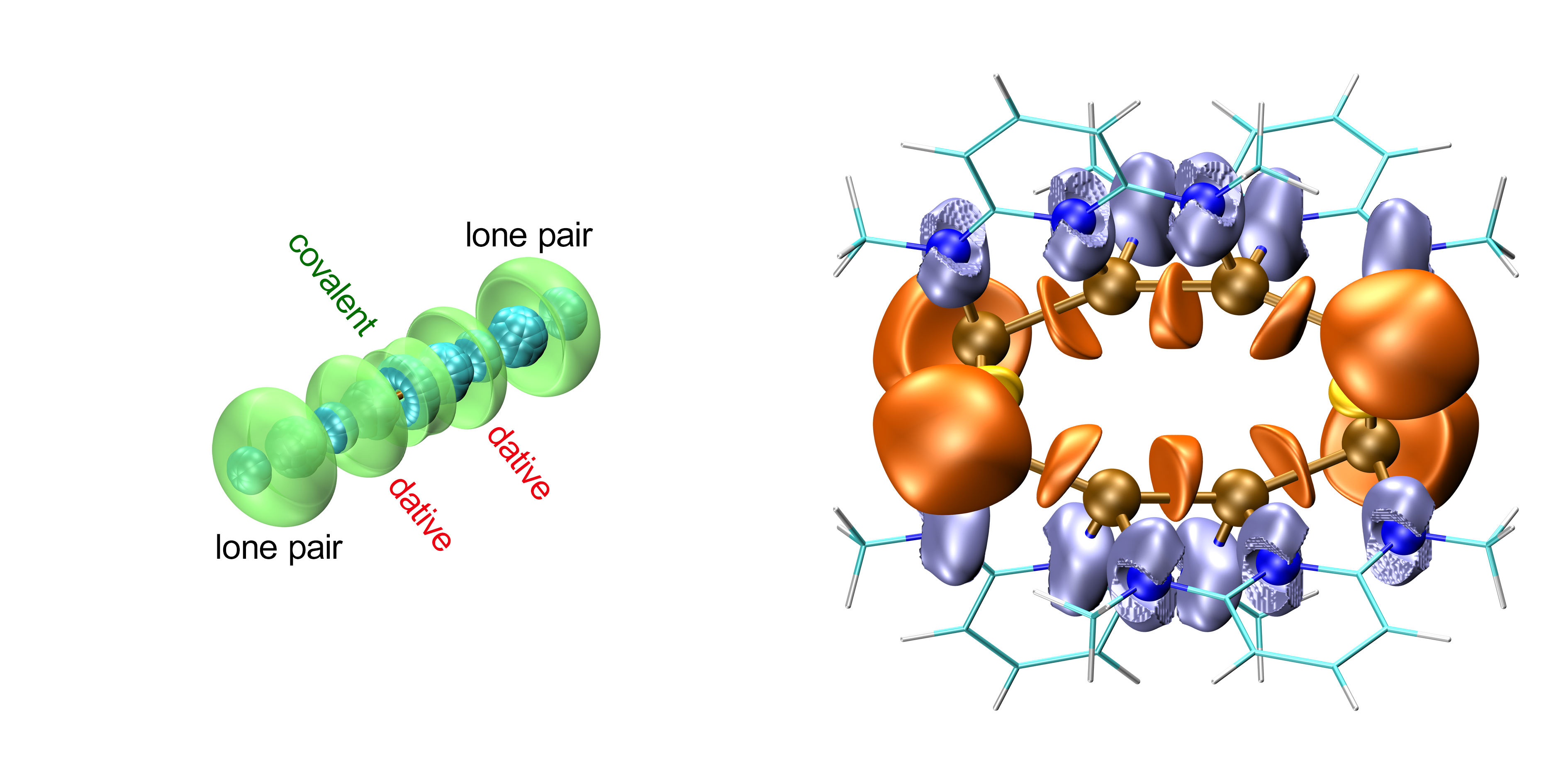
Dative bonds are commonly observed between atoms with different electronegativities. However, the AIM and ELF analysis of the electron density in germanium polycations at the B3LYP/6-31G(d,p) level shows conclusively that geometric and electronic constraints can enforce homonuclear dative bonds.

The dative bonds can be formally described as the interaction of a lone pair of a Ge ion in the center of the cluster with the overall positive charge of another Ge ion. At first glance, the dative bonds resemble weak covalent bonds, but can be readily distinguished from covalent bonds by the properties of the associated bond critical points in the AIM analysis and the shape of their ELF basins. The receiving Ge ion effectively draws electron density from central ions and the associated distribution of positive charge is stabilized by bracketing ligand anions.

The concept of homonuclear dative bonds can be used to rationalize counterintuitive charge pattern in polycations and offers a facile way to predict the disproportion of the germanium backbone of the cluster. 
Uncaptioned visual


IL070 Calculating Lewis-Structures and Curly Arrows from Ab-Initio Wavefunctions

Dr Timothy W Schmidt1, Dr Philip Kilby2, A/Prof. Terry J Frankcombe3, Prof. Timothy W Schmidt4
1UNSW, UNSW SYDNEY, Australia. 2Data 61, CSIRO, Canberra, Australia. 3UNSW, Canberra, Australia. 4UNSW, Sydney, Australia

Photo upload

Response to Photo upload

Abstract

Lewis structures and chemical mechanisms based on the “curly arrow” notation are at the heart of chemical thought. However, both are regarded with some suspicion – the connection with rigorous molecular quantum mechanics being unclear. The connection requires a view of the electronic wavefunction that goes beyond the molecular orbital approximation and rests on the most fundamental property of electrons. The (anti-)symmetry properties of electronic wavefunctions require that an N-electron wavefunction repeat itself in 3N dimensional space, thus exhibiting a “tiling”. Inspection of wavefunction tiles permits insight into chemical structure and mechanism. 

We demonstrate that analysis of the wavefunction tile reveals motifs such as: core electrons; lone-pairs; single-bonds; and banana-bonds. The structures determined for N2, O2, F2, and other molecules correspond to the double-quartet theory of Linnett.

Incorporation of multiple configurations into molecular orbital theory wavefunctions allows us to visualize static electron correlation. When the procedure is applied to C2, we arrive at an interpretation of its bonding in terms of a near triple bond with singlet-coupled outer electrons, closely resembling the quadruple bond posited by Shaik. Benzene reveals α and β electrons to occupy alternate Kekulé structures, as does ozone.

Analysis of the wavefunction tile along a reaction coordinate reveals the electron movements depicted by the canonical curly-arrow notation for several reactions: The Diels-Alder reaction is revealed to involve the separation and counter-propagation of electron spins.


IL071 The Enigmatic Quadruple Bonding in C2: What do the Excited States Tell?

Ms Ishita Bhattacharjee, Dr. Debashree Ghosh, Professor Ankan Paul
School of Chemical Sciences, Indian Association for the Cultivation of Science, Kolkata, India

Photo upload

Response to Photo upload

Abstract

Multiple bond order has attracted a lot of interest from the moment metal-metal bonding has been observed in transition metals and lanthanides/actinides where practically the maximum bond order can reach up to six bonds.[1] However, when it comes to the main group elements, the maximum bond order has remained three with one σ-bond and two π-bonds.The presence of a fourth bond in C2 was first suggested several decades back.[2] The interest on the presence of a fourth bond was reignited by Shaik and co-workers when they studied the bonding in the ground electronic state of C2 with Valence Bond Techniques.[3] They had even estimated the strength of the fourth bond in C2. However, other researchers have challenged this claim,[4] while there are others who have supported the presence of a fourth bond.[5] The debate surrounding the presence of the fourth bond is yet to be settled. We have tried to understand the bonding in C2 by conducting Multi-reference Configuration Interaction Studies on excited states of C2, diatomic systems isoelectronic to C2 and also on analogous diatomic systems belonging to the 2nd period. Insights from the excited state studies tend to tilt the balance towards a certain side of the dispute and can possibly seal the debate. In this talk the findings and the implications from these electronic structure studies would be discussed.  


References

  1. Cotton F.A., Inorg. Chem.1964,4,334-336.
  2. Schleyer P.V.; Maslak P., Tetrahedron Letters, 1993, 34, 6387-6390.
  3. (a) Shaikh S.; Danovich D.; Wu W.; Su P.; Rzepa H. S.; Hiberty P.C., Nat. Chem., 2012, 4, 195-200. 
  4. Frenking G.; Hermann M., Angew. Chem. 2013, 125, 6036 – 6039. 
  5. Karadakov, P. B.; Kirsopp, J.  Chem. Eu. J. 2017, 23, 12949 – 12954.

IL072 Theoretical Analysis of Donor-Acceptor Bonding

Associate Professor David J Wilson
La Trobe University, Melbourne, Australia

Photo upload

Response to Photo upload

Abstract

Both the use of carbenes and utilisation of donor-acceptor bonding have had a significant impact on main-group and s-block chemistry over the last decade. Here, we present results from recent investigations into the use of carbene ligands to stabilise s-block and main group elements, which have also resulted in experimental observations of unusual reactivity. Theoretical calculations have been critical to understanding the electronic structure and reactivity of these systems. In particular, energy decomposition analysis (EDA) has proven a powerful technique to probe the nature of bonding interactions. 

A particular focus of this talk is the chemistry and electronic structure of beryllium and boron-containing heterocyclic systems. Beryllium, despite its toxicity, exhibits the greatest covalent tendency of the group 2 elements. Results will be presented utilising novel ligands to stabilise Be-containing compounds with donor-acceptor bonding. For boron heterocycles, theoretical results will be presented of a comparison of N-heterocyclic carbene (NHC) and boryl anions (boron analogues of NHC) and their propensity for pi-backbonding with metals. 


IC051 A Density Functional and Wave Function Theory-based Study on the Mechanism of Oxygen Atom Attack on Polycyclic Aromatic Hydrocarbon

Dr. Aulia S Hutama
Department of Chemistry, Universitas Gadjah Mada, Yogyakarta, Indonesia. Austrian-Indonesian Center for Computational Chemistry, Yogyakarta, Indonesia

Photo upload

Response to Photo upload

Abstract

Potential energy curves (PECs) and energy profiles of atomic O attack on some polycyclic aromatic hydrocarbons (PAHs) as models for graphene/graphitic surface have been computed at the density functional theory level of theory to elucidate the mechanism of O attack and chemisorption to PAHs as graphene models. The PECs were obtained by scanning the O atom distance to the nearest carbon atom on "top" and "bridge" positions in coronene, while the energy profile was obtained from the fully relaxed geometries in triplet states. The possibility of an intersystem crossing from triplet to singlet state will be verified by the multireference wave function theory calculations. We proposed a mechanism of O attack and chemisorption reaction on PAHs starting from the non-interacting O and PAHs systems into the chemically bound O on PAHs.


IC052 Exploration of the Differences between Amine and Thiolate Addition to Acetylenedicarboxylates.

Dr Renate L Griffith1, Dr Robyn L Crumbie2
1School of Chemistry, UNSW Sydney, Sydney, Australia. 2School of Science and Health, Western Sydney University, Sydney, Australia

Photo upload

Response to Photo upload

Abstract

Nucleophilic addition of thiolates to diethyl acetylenedicarboxylate in chloroform at room temperature affords solely the meso dithioaddition product, whereas the addition of amines in ethanol gives only the corresponding (Z)-enamine, as confirmed by X-ray crystal analysis. The monoaddition product of thiolate addition, prepared and isolated at lower temperatures, also exhibited (Z)-stereochemistry. Our computational study on simplified model systems explains the reasons for the observed stereochemistry and why the acetylene dicarboxylate readily undergoes two addition reactions with thiolate nucleophiles, whereas the (Z)-enamine is much less reactive towards addition of thiolate or amine nucleophiles. Gibbs free energy values (Go) of reactants, intermediates, products and transition states were obtained after a final geometry optimisation at DFT level (ωB97X-D/6-31G*)1 in a C-PCM implicit solvent model2,3, followed by calculation of the IR spectra and thermodynamic quantities as implemented in the Spartan software (wavefun.com).

References:

  1. Chai, J.-D.; Head-Gordon, M.: Long-range corrected hybrid density functionals with dampened atom-atom dispersion corrections. Phys. Chem. Chem. Phys. 2008, 10(44), 6615-6620.
  2. Barone, V.; Cossi, M.: Quantum calculation of molecular energies and energy gradients in solution by a conductor solvent model. J. Phys. Chem. A 1998, 102, 1995-2001.
  3. Lange, A.W.; Herbert, J.M.: Symmetric versus asymmetric discretisation of the integral equations in polarizable continuum solvation models. Chem. Phys. Lett. 2011, 509(1-3), 77-87.